Returning a Result
Some flows produce a result - a token, a record id, an approval decision. A Return Result block is how that value leaves the flow and reaches whatever called it. The caller sees only what you put there; the rest of what the run did stays inside.
Not every flow needs one. A flow that files a record or sends a notification may have nothing to hand back, and it runs to completion without a Return Result.
Who reads what you return
- a Call Flow block in another flow, which reads it through that block's own alias - a parent step reads Issue Token Result → token;
- a SubFlow block running these steps inline;
- an AI Agent that has been given the flow as a tool - what you return is what the agent gets to reason with. See Flows as Agent Tools;
- a system calling the flow over the REST API on the blocking endpoint, which gets the composed result as the response body. See Calling a flow that returns a value.
Compose the answer
Put a Return Result at the end of the path the run will take, and decide two things: Content Type sets the format the caller receives - JSON, XML, or plain text - and Compose Result decides how you build it. With it on, you add a row per property, each pairing a Property name with a Value expression, so you hand back exactly the object you meant to. With it off, the block returns a single value from one expression, for when the answer is a single value.
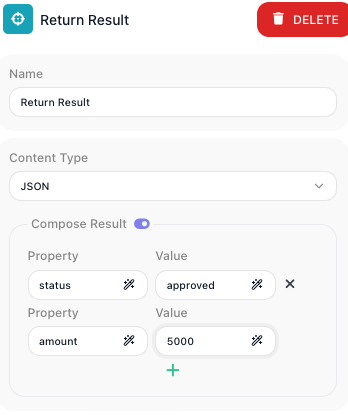
It ends the path it is on
Return Result is terminal: the block has no outbound connector, so nothing can be wired after it. A path that reaches one composes its answer and ends there. Put it where that path's work is genuinely finished - anything else the path has to do belongs before it.
When more than one can run
It is normal to put a Return Result on each branch of a Condition, and that changes the shape the caller sees. Reach more than one and the caller no longer gets a plain object - it gets an envelope holding the first result, every result that ran tagged with the block name that produced it, and an overall status.
So make it a deliberate choice:
- Want the caller to read a simple object? Keep to one Return Result on any path a run can take.
- Several genuinely can run? Expect the envelope, and name those blocks meaningfully, because the caller picks its result out by the producing block's name.
Design the answer for the caller
The result is your flow's contract with whoever calls it, so treat it like one:
- Return what the caller needs to act on, not everything you have. A new record's id and status beats the raw response you happened to get back from a service.
- Keep the shape stable. Callers build on the property names you return, so renaming one later breaks them.
- Do not leak internals. Credentials, raw third-party payloads, and ids that mean nothing outside this flow should stay inside it.
Related
- Return Result - every field, the envelope, and a worked example
- Running Another Flow - the calling side, and reading what comes back
- Flows as Agent Tools - what an agent does with a returned result
- Calling an External Service - the other direction: your flow calling out