Break
Placed inside a loop, this block ends the loop early: when the flow reaches it, the loop stops and the flow carries on after it, leaving any not-yet-processed items untouched.
How it works
Think of it as the loop's early exit. You rarely want every iteration once you have found what you came for, so you fire the Break the moment you have it - which is why it almost always sits behind a Condition that decides when "done enough" is true. Reaching it drops you out of the loop and on to whatever follows.
Break breaks the loop it sits inside - the nearest enclosing one. If you have nested loops, it ends only the inner loop and the outer loop keeps going, because the block belongs to whichever loop currently surrounds it. It hands nothing back either: there is no result to read after a Break, so nothing downstream references it - its whole job is to change where the flow goes next, not to produce a value. You will find Break in the palette's Utils group.
When to use it
Use it when you do not always need to finish the whole loop: stop as soon as you have found the item you were looking for, hit a situation where you should bail out, or reached a limit you set. Pair it with a Condition so the loop breaks only when you mean it to.
Example
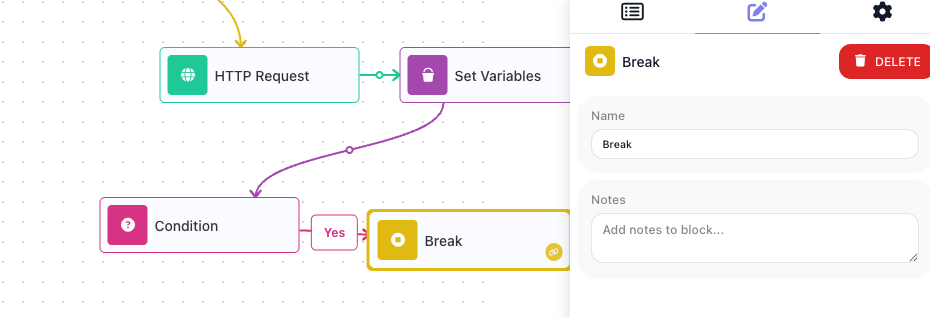
Break lives inside a List Iterator or Repeat loop, usually right after a Condition: when the flow reaches it, the loop stops. The block itself has almost nothing to configure - just a Name for the canvas and optional Notes. It exposes no result, so unlike most blocks there is no output alias to read afterwards; the screenshot below shows the whole panel:
Configuration
Common settings (available on most blocks):
| Field | Description |
|---|---|
| Name | A label for this block on the canvas. |
| Notes | Freeform notes for documenting the block; they do not affect execution. |
Behavior
- Reaching the Break ends the enclosing loop immediately; remaining items are not processed.
- The flow continues from whatever comes after the loop.
Things to watch for
- Break only makes sense inside a List Iterator or Repeat loop; outside a loop it has nothing to exit.
- It is almost always placed after a Condition, so the loop stops only when your test is met rather than on the first item.