Billing
How much your automations can run is set by your plan. Every workspace has a monthly execution allowance - the number of times its flows may run in a month - and the Billing page is where you see which plan you are on, what each one offers, and move to a larger one when your flows start to outgrow their room. That same allowance is what the executions counter at the top of the navigation counts against.
What counts as an execution
An execution is one run of a flow - one instance. Each time a flow produces an instance, the counter goes up by one, and that single count covers everything the run does from beginning to end. A run that works through fifty blocks counts the same one as a run through two: the loops, retries, waits, and parallel branches inside it add nothing on their own.
Only a LIVE version of a flow produces billable instances - a version you are still building or testing produces none. An instance counts when:
- The LIVE flow is set off on its own - a trigger fires, a schedule comes due, a form is submitted, or an outside system calls it over the API.
- You launch one by hand with Run Instance on the LIVE flow.
- One flow runs another as a step, with a Call Flow block or from the Flows as Actions palette. The called flow starts its own instance, so it spends its own execution on top of the flow that started it.
These do not spend an execution:
- Test runs. Trying a flow out while you build it - running it from the editor to watch what it does - is free. Only Run Instance on a LIVE flow is billable.
- An inline SubFlow. It runs as part of the same instance, so it adds nothing.
A run counts from the moment it starts, whether or not it ends well. A flow that begins and then errors out has still produced an instance, so it spends an execution the same as one that finishes cleanly.
Plans and allowances
FlowRunner™ offers a ladder of plans - Growth, Professional, and Business - each trading a higher monthly price for a larger execution allowance, plus a custom Enterprise plan for needs beyond Business. The cards show each plan's price and monthly allowance side by side.
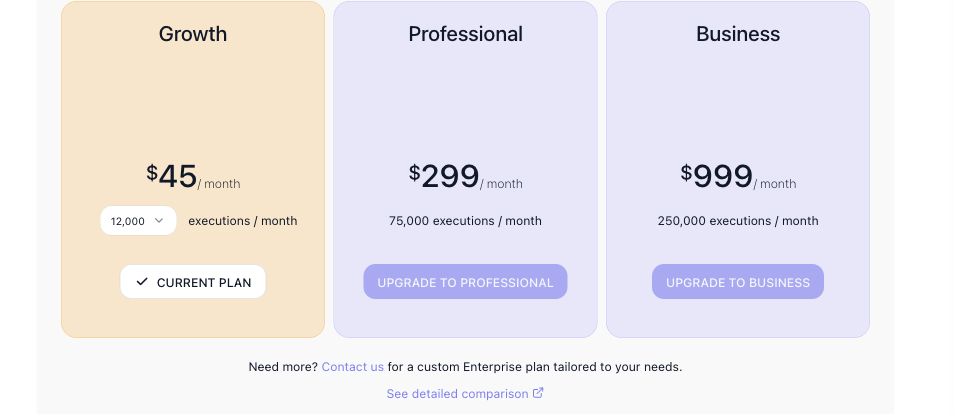
The plan you are on is marked CURRENT PLAN, and a selector beside its price raises that plan's execution allowance without moving plans. To move up instead, use the plan's upgrade button; See detailed comparison opens the full plan-by-plan breakdown, and Contact us arranges an Enterprise plan. When your flows begin bumping against the allowance - the executions counter climbing toward its limit before the month is out - raise the allowance or move up a plan to give them more room.
Payment profiles
Before a workspace can be charged - moved onto a paid plan, or up from the one it is on - it has to be tied to a payment profile. Until it is, the upgrade buttons stay disabled, and a free-credit balance shown at the top of the Billing page keeps your flows running in the meantime.
You add and manage payment profiles on the account-level Payment Profiles page, reached from your account menu at the bottom of the left navigation. It has two parts.
The first lists your payment profiles - the payment methods on your account. Add a payment profile hands off to a secure Stripe checkout to enter your details; each saved profile then shows its type, its identifier, and the workspaces it covers.
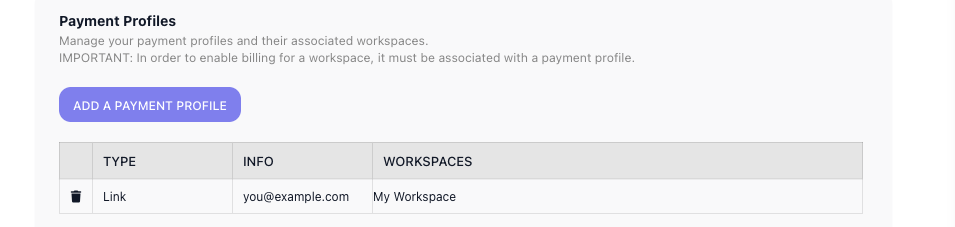
The second is a Workspaces overview - every workspace you have, each with its billing plan, the payment profile assigned to it, and its subscription renewal date. You assign a workspace's payment profile from this table; you change its plan back on the workspace's own Billing page.
Related
- Workspace - the executions counter, and the areas a workspace holds